A modern jacquard loom uses digital files and individual electronic actuators to control up to 24,576 warp threads simultaneously, whereas a traditional mechanical Jacquard loom relies on punched pasteboard cards to lift a maximum of 400 to 800 threads. Modern machines operate at speeds exceeding 800 picks per minute compared to the 150 picks per minute of mechanical predecessors.

Mechanical, electromagnetic, and electronic Jacquard loom eras
The evolution of Jacquard weaving spans three distinct technological eras defined by the method of warp thread selection. The original mechanical Jacquard loom, invented by Joseph Marie Jacquard in 1804, reads physical holes punched into continuous chains of pasteboard cards. The mechanical Jacquard loom limits pattern repeats to the physical length of the card chain and typically controls 400 hooks.
Textile engineers introduced the electromagnetic Jacquard loom in the 1970s. The electromagnetic Jacquard loom replaces mechanical reading needles with solenoids. Solenoids read pattern data from early magnetic tapes or floppy disks. The electromagnetic Jacquard loom increases hook capacity to 1,200 hooks and raises weaving speeds to 400 picks per minute.
The fully electronic jacquard loom modern era began in 1983 with the introduction of individual electronic actuators. An electronic Jacquard loom eliminates all mechanical reading components. The electronic Jacquard loom receives pattern instructions directly from computer-aided design (CAD) software. The electronic Jacquard loom controls up to 24,576 individual warp threads and weaves complex designs without any physical pattern length restrictions.
| Era | Technology | Maximum Hook Count | Speed (Picks per Minute) | Pattern Storage Method |
|---|---|---|---|---|
| 1804 to 1970s | Mechanical | 400 to 800 hooks | 100 to 150 PPM | Punched pasteboard cards |
| 1970s to 1983 | Electromagnetic | 1,200 to 2,400 hooks | 300 to 400 PPM | Magnetic tape and floppy disks |
| 1983 to Present | Electronic | 12,288 to 24,576 hooks | 800 to 1,200 PPM | Digital files (.JC5, .EAT) |
Sarelli Interiors Textiles operates electronic Jacquard looms to produce the Sarelli Fabrics catalog and the specific Fabrics Collection. The electronic Jacquard loom allows Sarelli Interiors Textiles to weave intricate botanical and geometric patterns with zero physical card storage requirements.
Hook count and pattern complexity in a modern jacquard loom factory
Hook count dictates the maximum width of a unique pattern repeat before the pattern must mirror or duplicate across the fabric width. A traditional mechanical Jacquard loom features 400 hooks. A 400-hook mechanical loom weaving a fabric with 40 warp threads per centimeter restricts the unique pattern width to exactly 10 centimeters.
A modern jacquard loom factory installs electronic Jacquard machines featuring 12,288 to 24,576 hooks. An electronic Jacquard loom equipped with 12,288 hooks weaving a fabric with 40 warp threads per centimeter produces a unique pattern repeat measuring 307.2 centimeters wide. The 307.2-centimeter width allows textile designers to create full-width murals and non-repeating organic motifs across standard 300-centimeter wide interior fabrics. A 24,576-hook machine doubles the unique pattern width to 614.4 centimeters at the identical warp density.
The increased hook capacity directly impacts Fabrics Composition options. Electronic Jacquard looms manage multiple warp beams simultaneously. Managing multiple warp beams allows a modern jacquard loom to weave complex structures combining a 100 percent silk warp with a 100 percent linen weft. The independent control of 12,288 hooks enables the creation of multi-layered pocket weaves, brocades, and high-density damasks weighing up to 800 grams per square meter (GSM).
Operating speeds and production efficiency of a modern jacquard loom
Weaving speed is measured in picks per minute (PPM), representing the number of weft threads inserted across the warp in sixty seconds. A traditional mechanical Jacquard loom operates at a maximum speed of 150 picks per minute. A mechanical Jacquard loom weaving a fabric with 30 weft threads per centimeter produces exactly 30 centimeters of fabric per hour.
A modern jacquard loom operates at speeds ranging from 800 to 1,200 picks per minute. A modern jacquard loom running at 800 picks per minute and weaving a fabric with 30 weft threads per centimeter produces 160 centimeters of fabric per hour. The 433 percent increase in production speed reduces lead times for custom textile orders.
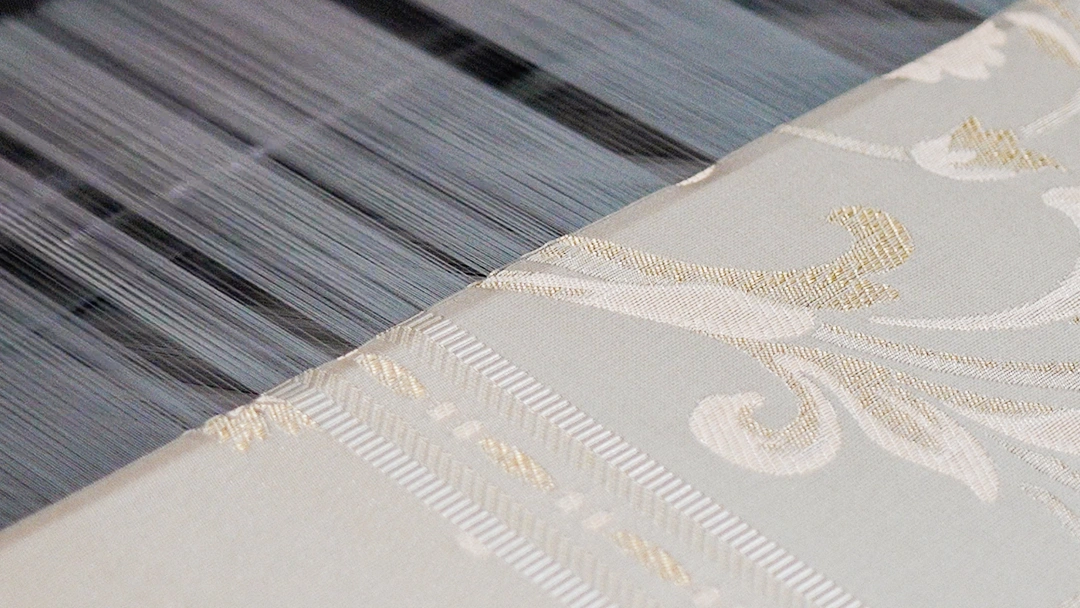
The high-speed operation of a modern jacquard loom requires advanced weft insertion systems. Modern electronic Jacquard heads mount onto rapier or air-jet weaving machines. Rapier weaving machines use rigid or flexible rods to carry the weft yarn across the shed. Air-jet weaving machines propel the weft yarn across the shed using a burst of compressed air. Sarelli Interiors Textiles details these specific Production Methods to ensure clients understand the technical capabilities behind heavy drapery and upholstery fabrics.
Digital pattern files replacing punched pasteboard cards
The transition from physical punched cards to digital pattern files represents the most significant operational change in Jacquard weaving. A traditional mechanical Jacquard loom requires one physical pasteboard card for every single weft insertion in a pattern repeat. A mechanical Jacquard loom weaving a design with 5,000 weft insertions requires a continuous chain of 5,000 pasteboard cards. A 5,000-card chain weighs approximately 50 kilograms and requires dedicated physical storage space.
A modern jacquard loom reads digital pattern files formatted as .JC5 or .EAT extensions. Textile designers create .JC5 files using specialized computer-aided design software. The CAD software translates pixel data into binary lift instructions for the electronic actuators. A digital pattern file containing 50,000 weft insertions occupies less than 5 megabytes of digital storage space. The 5-megabyte file transfers from the CAD workstation to the loom controller via Ethernet cables or USB drives in under ten seconds.
Digital pattern files eliminate the mechanical setup time associated with changing card chains. A loom technician changes a digital pattern file on a modern jacquard loom in less than two minutes via a touchscreen interface. The rapid pattern changeover capability allows textile manufacturers to weave short custom runs of 50 meters economically. Clients visiting the Sarelli Interiors Textiles Showroom frequently request custom colorways, which the digital workflow accommodates without requiring new physical tooling.
The digital workflow also supports delicate Sheer Fabrics Production. Sheer fabrics require precise tension control and complex binding structures to prevent yarn slippage. The CAD software automatically applies specialized binding weaves to the digital pattern file, ensuring the modern jacquard loom executes the sheer fabric structure flawlessly.
Sarelli Interiors Textiles modern Jacquard weaving capabilities
Sarelli Interiors Textiles integrates modern electronic Jacquard technology to execute complex interior design Projects. The Sarelli Interiors Textiles production facility operates electronic Jacquard looms equipped with 12,288 hooks. The 12,288-hook capacity allows Sarelli Interiors Textiles to weave bespoke fabrics measuring 300 centimeters wide with zero pattern repetition. The electronic Jacquard loom processes natural fibers including 22-momme silk, long-staple Egyptian cotton, and Belgian linen alongside high-performance Trevira CS synthetic yarns.
Clients requiring custom Jacquard fabrics can submit digital artwork to the Sarelli Interiors Textiles design team. The design team converts the digital artwork into .JC5 loom files within 48 hours. Sarelli Interiors Textiles requires a minimum order quantity of 50 linear meters for custom Jacquard weaving projects. Interior designers and architects can reach out via the Contact page to initiate custom fabric development.
The combination of high-speed rapier insertion and electronic warp control ensures Sarelli Interiors Textiles delivers custom Jacquard fabrics within a standard lead time of four to six weeks. The modern jacquard loom technology guarantees exact pattern reproduction across multiple production batches, maintaining strict quality control for large-scale hospitality and residential installations.