The hand tufted carpet manufacturing process requires eight sequential stages spanning 4 to 12 weeks. Sarelli Interiors Textiles executes these eight stages using manual pneumatic tools, natural latex adhesives, and 100 percent New Zealand wool or botanical silk. The manufacturing cycle transforms raw yarn into a finished custom carpet weighing between 3.5 and 5.5 kilograms per square meter.
Buyers seeking detailed specifications regarding Hand-Tufted Production can review the exact technical parameters applied to all Sarelli Rugs & Carpets during the fabrication cycle.
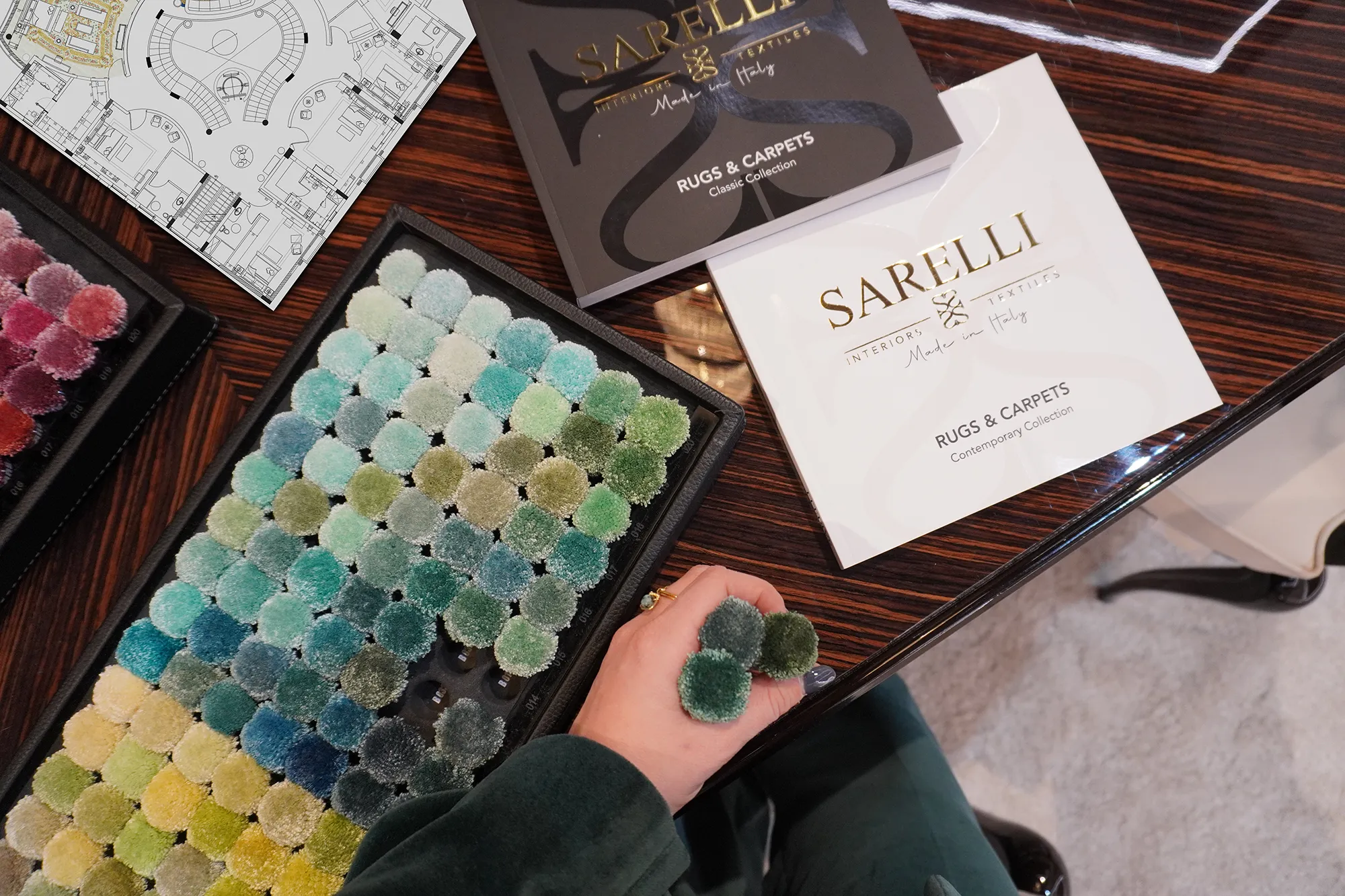
Stage 1: Design cartoon creation and transfer
Sarelli artisans begin hand tufted rug making by drawing a 1:1 scale paper template called a cartoon. The design team projects the digital pattern onto a heavy paper roll measuring up to 5 meters wide. Artisans trace the projected lines using charcoal pencils. Workers then perforate the paper cartoon along the charcoal lines with a spacing of 2 millimeters between holes. The production team pins the perforated paper to a stretched cotton canvas and rubs a contrasting pigment powder over the holes. The pigment powder passes through the perforations to leave a precise dotted outline on the primary cotton backing. Customers can view examples of these initial designs in the Sarelli Projects portfolio.
Stage 2: Primary backing frame stretching
The production team stretches the marked cotton canvas across a vertical steel frame. The steel frame measures up to 6 meters wide by 4 meters high. Workers secure the cotton canvas to the steel frame using industrial tension hooks spaced every 10 centimeters along the perimeter. The tension hooks apply 50 kilograms of pulling force per square meter. Proper canvas tension prevents the carpet pattern from distorting during the heavy yarn insertion phase. The primary cotton canvas features a woven grid structure with 60 threads per 10 centimeters. The woven grid structure guides the artisans during the yarn insertion phase.
Stage 3: The hand tufting process execution
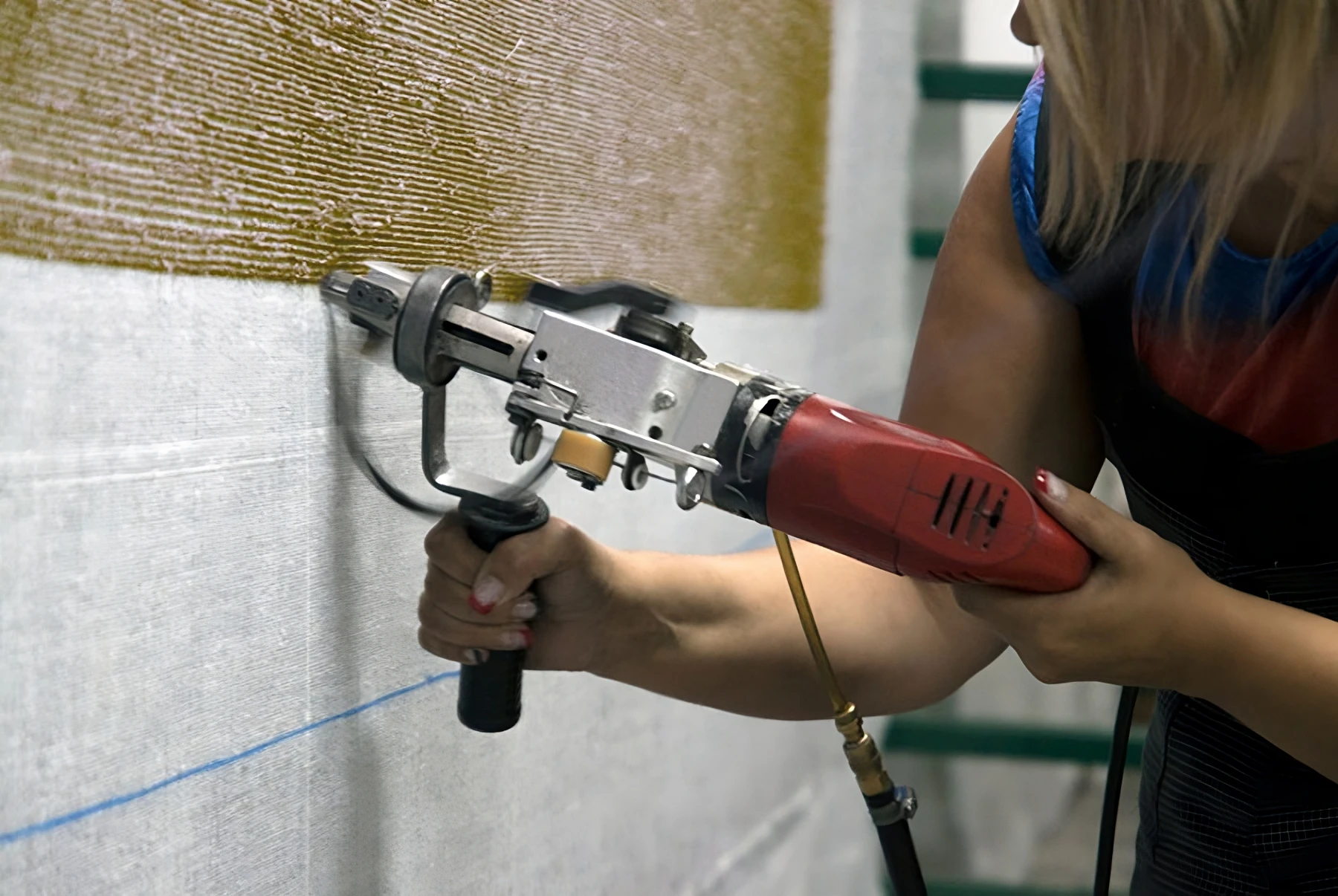
The hand tufting process involves artisans using a pneumatic tufting gun to inject yarn through the stretched cotton canvas. The pneumatic tufting gun operates at an air pressure of 6 to 8 bar. Artisans load the tufting gun with specific Rug Materials, such as 380-tex wool yarn or 120-tex bamboo silk. The tufting gun pushes the yarn through the canvas to form loops on the front side of the carpet. A skilled artisan completes between 0.5 and 1.5 square meters of tufting per 8-hour shift. The tufting speed depends on the design complexity and the required pile height. Pile heights range from 8 millimeters for flat designs to 16 millimeters for plush textures.
Stage 4: Primary latex application
Once the artisans complete the yarn insertion, the tufted carpet remains on the vertical steel frame. Workers apply a layer of natural liquid latex to the back of the cotton canvas. The natural liquid latex secures the individual yarn tufts permanently into the cotton canvas structure. Sarelli production staff spread the liquid latex evenly using wide metal spatulas at a coverage rate of 800 grams per square meter. The natural liquid latex contains 60 percent solid rubber particles suspended in an aqueous solution. The aqueous solution evaporates during the curing process. The latex layer requires 24 to 48 hours to cure completely in a climate-controlled drying room maintained at 30 degrees Celsius and 40 percent relative humidity.
Stage 5: Hand carving and shearing
The production team removes the cured carpet from the vertical frame and places the carpet flat on the floor. Artisans perform hand carving using electric scissors and manual clipping shears. The carving process creates three-dimensional definition between different color blocks or design elements. Following the carving phase, workers pass a heavy rotary shearing machine over the entire carpet surface. The rotary shearing machine features a 60-centimeter cylindrical blade spinning at 1200 revolutions per minute. The shearing machine levels the carpet pile to an exact uniform height with a tolerance of 1 millimeter. Clients exploring Bespoke Customization options often request multi-level carving to highlight specific geometric patterns.
Stage 6: Secondary backing attachment
Workers apply a second layer of natural latex adhesive over the cured primary latex layer. The production team immediately presses a secondary backing material onto the wet adhesive. Sarelli uses a heavy cotton scrim fabric weighing 250 grams per square meter for the secondary backing. The secondary backing attachment process requires two workers operating simultaneously to prevent the heavy cotton scrim from wrinkling. The heavy cotton scrim fabric measures 2 millimeters in thickness. The cotton scrim fabric provides dimensional stability and protects the floor surface from the rough primary latex. Workers use heavy steel rollers weighing 25 kilograms to press the cotton scrim into the adhesive. The steel rollers eliminate air bubbles and ensure 100 percent contact between the layers.
Stage 7: Edge trimming and binding
The finishing team trims the excess cotton canvas and secondary backing from the carpet perimeter using heavy-duty industrial shears. Workers fold the remaining 3 centimeters of canvas under the carpet edge. Artisans then bind the folded edge using a specialized overlock sewing machine or apply a hand-sewn cotton tape binding. The edge binding prevents the carpet perimeter from fraying during daily use. The binding thread matches the primary border color selected during the Colors & Samples approval phase.
Stage 8: Quality control and final inspection
The final stage of the hand tufted carpet manufacturing process involves a rigorous 20-point quality control inspection. Inspectors measure the finished carpet dimensions to verify compliance with the specified size within a 2 percent tolerance. The quality control team uses a digital moisture meter to confirm the latex backing contains less than 5 percent residual moisture. Inspectors manually check the carpet surface for loose threads, uneven pile heights, or missing tufts. Workers vacuum the finished carpet using a dual-motor industrial vacuum cleaner to remove loose shearing dust. The shipping department rolls the approved carpet around a rigid cardboard tube measuring 15 centimeters in diameter before wrapping the roll in waterproof polyethylene film. Customers can view finished examples in the Sarelli Rugs Collection or visit the Showroom. For specific inquiries, buyers can reach out via the Contact page.