An Aubusson rug is a flat-woven, pileless carpet originating from the French town of Aubusson in the 14th century. The Aubusson weaving technique uses an interlocking warp and weft method to create a reversible textile. Authentic Aubusson carpets feature floral motifs, architectural medallions, and pastel color palettes.
Aubusson rug construction and flat-weave specifications
The construction of an Aubusson rug relies on a slit-weave method that produces zero pile height. Weavers interlace dyed wool weft threads through undyed cotton or linen warp threads. The undyed cotton warps serve as the structural foundation for the Aubusson textile.
The flat-weave structure dictates that an Aubusson carpet measures between 4 millimeters and 6 millimeters in total thickness. A standard Aubusson rug weighs approximately 1,200 to 1,500 grams per square meter (GSM). The undyed cotton warp yarns are standard Rug Materials for this historical category. Buyers seeking thicker floor coverings often explore Hand-Tufted Production methods instead.
Material composition and yarn density in aubusson style rugs
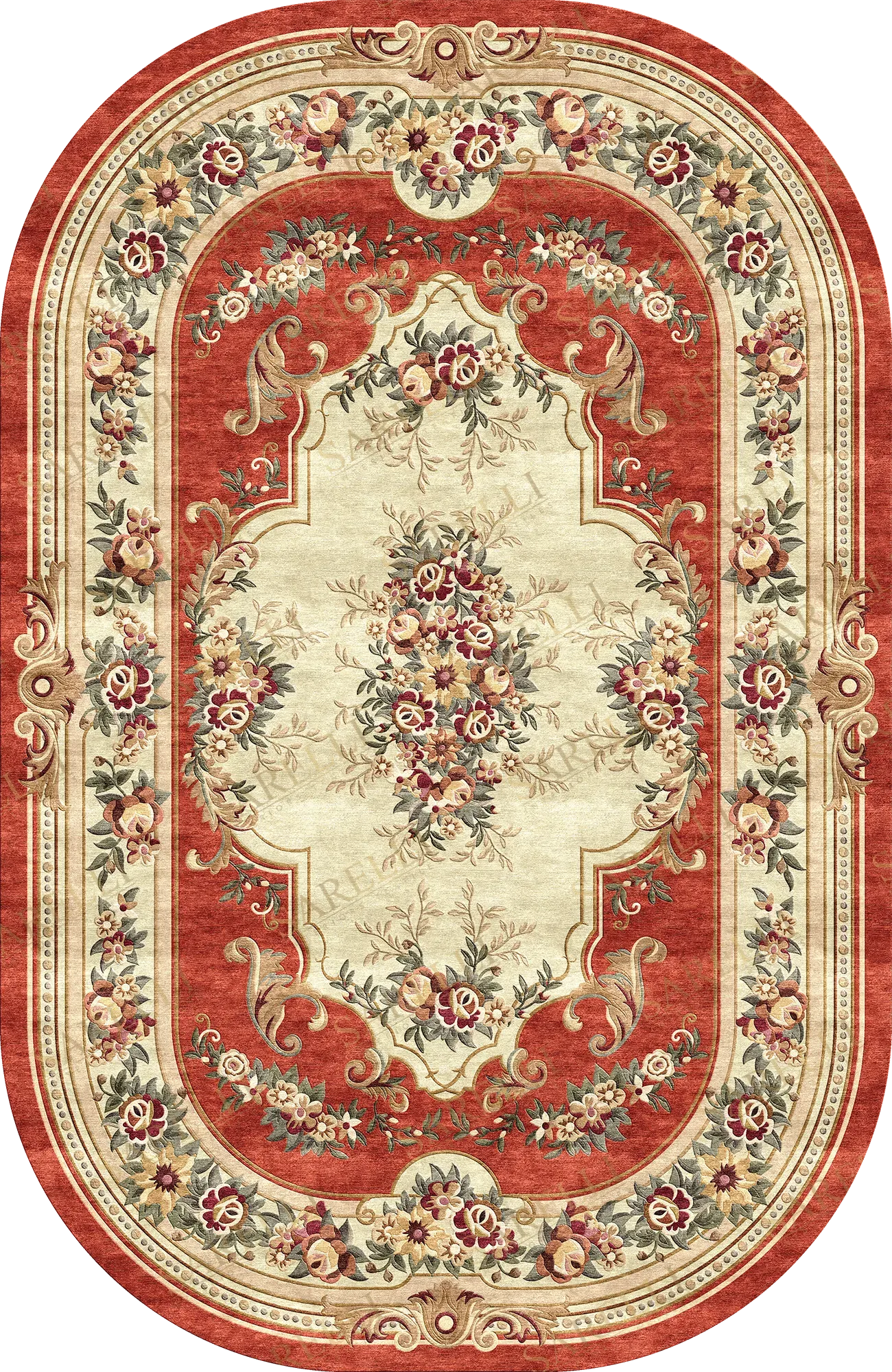
Contemporary aubusson style rugs contain a blend of New Zealand wool and natural silk. The New Zealand wool provides structural integrity to the flat-weave, while the natural silk adds a reflective sheen to specific floral motifs. A high-quality Aubusson weave contains 14 to 16 warps per inch. The 16-warp density requires a weaver to spend 200 to 250 hours to complete one square meter of Aubusson fabric. The Aubusson Garden Oval demonstrates this precise 16-warp density. Sarelli Interiors Textiles offers Bespoke Customization to adjust the wool-to-silk ratio based on client specifications. A custom Aubusson rug order typically requires a lead time of 16 to 20 weeks for completion.
Historical origins of tappeti aubusson in 14th century France
The production of tappeti aubusson began in the Creuse valley of central France during the 1330s. Flemish weavers migrated to the Aubusson region to establish wooden Jacquard looms near the Creuse river. The natural minerals present in the Creuse river water provided optimal chemical conditions for dyeing raw wool yarns.
By 1665, King Louis XIV granted the Aubusson weaving workshops the official title of Royal Manufactory. The Imperial Rococo Flourish design reflects the ornate architectural patterns developed during this 17th-century royal patronage. The French government still protects the Aubusson weaving technique under national heritage laws.
Color palettes and dyeing techniques for the classic aubusson collection
A classic aubusson collection features a distinct pastel color palette dominated by rose pink, sage green, ivory, and dove grey. The dyeing process for Aubusson wool yarns requires precise temperature control at 85 degrees Celsius for exactly 45 minutes to achieve these muted historical tones. Sarelli Interiors Textiles maintains a physical archive of 400 historical dye formulas. Clients can review these exact pastel shades by requesting Colors & Samples before commissioning a new Aubusson piece. The Majilis Regal Aubusson incorporates 24 distinct dye lots to render the intricate floral borders of the carpet.
Technical comparison of Aubusson flat-weaves and knotted carpets
The physical properties of an Aubusson rug differ significantly from traditional hand-knotted Persian or Turkish carpets. The Aubusson slit-weave technique creates visible gaps between color changes along the vertical axis. A hand-knotted carpet features a continuous pile surface anchored to the warp foundation.
The lack of pile in an Aubusson rug reduces the total weight of the textile by 40 percent compared to a 60-knot-per-square-inch hand-knotted rug. The structural differences dictate specific applications for each carpet type.
| Technical Specification | Aubusson Flat-Weave Rug | Hand-Knotted Pile Rug |
|---|---|---|
| Average Thickness | 4 to 6 millimeters | 12 to 18 millimeters |
| Weight per Square Meter | 1,200 to 1,500 GSM | 3,500 to 4,500 GSM |
| Reversibility | Fully reversible pattern | Single-sided pattern |
| Production Time (10 m²) | 2,000 to 2,500 hours | 3,000 to 4,000 hours |
Maintenance and durability of reversible Aubusson carpets
The flat-weave construction makes an Aubusson rug fully reversible. Owners can flip the Aubusson carpet every 12 to 18 months to distribute foot traffic wear evenly across both sides of the textile. A well-maintained Aubusson rug lasts 50 to 80 years under moderate residential use.
Professional cleaning for an Aubusson textile requires a dry-cleaning solvent process rather than hot water extraction. Hot water extraction can cause the 1,500 GSM wool structure of the Aubusson rug to shrink by 3 to 5 percent. Direct sunlight exposure will fade the pastel Aubusson dyes by 10 to 15 percent over a 10-year period.
Geometric properties and floral motifs in Aubusson rug patterns
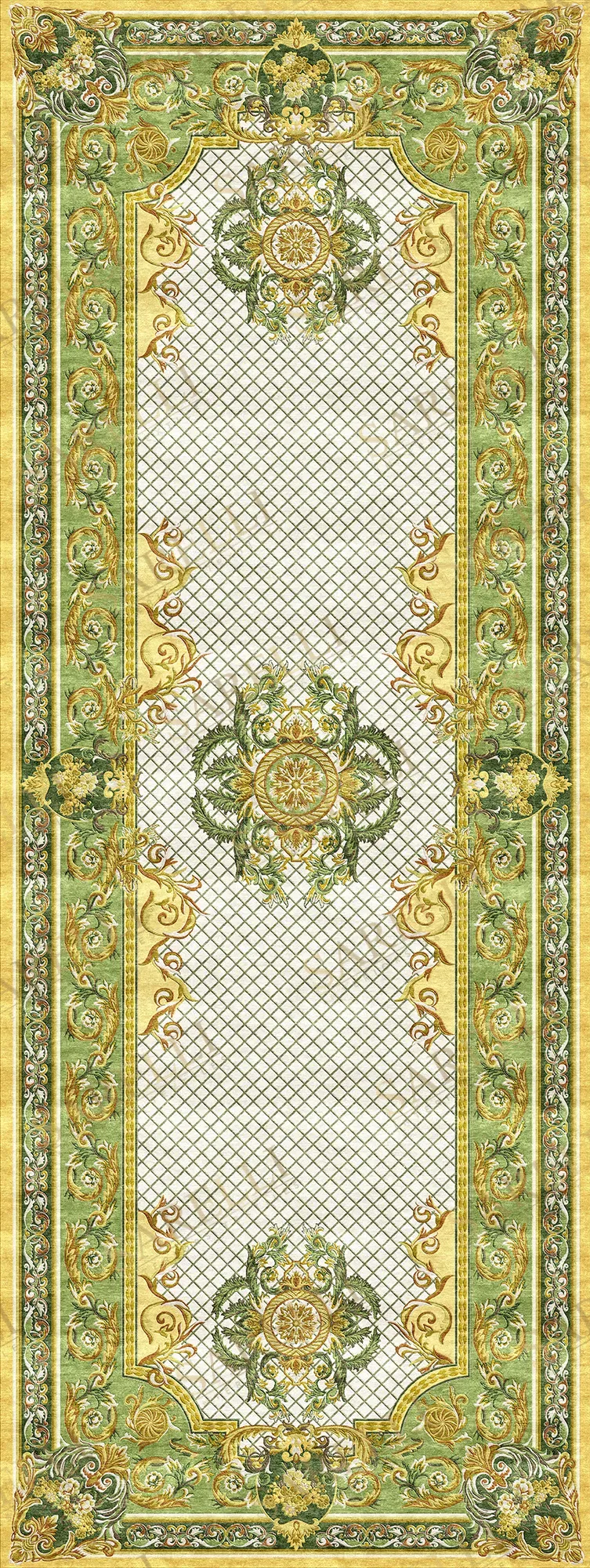
The visual identity of an Aubusson rug relies on strict geometric symmetry and centralized floral arrangements. Weavers construct the central medallion of an Aubusson carpet using a Cartesian grid system. The Cartesian grid system ensures perfect mirroring across the longitudinal and latitudinal axes of the textile.
The outer borders of an Aubusson rug typically measure between 25 centimeters and 40 centimeters in width, depending on the total dimensions of the carpet. The Aubusson borders often contain woven representations of acanthus leaves. The woven representations of acanthus leaves require 8 to 10 distinct shades of green wool to achieve a three-dimensional trompe l’oeil effect. The flat-weave technique allows weavers to create curved floral lines that appear smoother than the pixelated curves seen in low-density knotted carpets. A standard 3-meter by 4-meter Aubusson rug contains over 1.2 million individual weft insertions.
Integration of Aubusson designs in contemporary interior architecture
Interior designers specify Aubusson rugs for formal dining rooms and classical reception areas. The 4-millimeter thickness allows interior doors to clear the Aubusson rug surface without binding against the fabric. Sarelli Interiors Textiles documents the installation of these flat-weave carpets in various European estates within the Projects portfolio. Clients can view physical examples of the flat-weave technique at the Sarelli Showroom in Italy. The Versailles Floral Medallion remains a frequently requested pattern for dining rooms measuring larger than 40 square meters. For general inquiries about Aubusson sizing and international shipping, clients should use the Contact page. The full Rugs Collection includes both flat-weave Aubusson designs and thicker pile options. The base price for a custom Aubusson rug starts at 850 EUR per square meter.