A Jacquard loom operates as a mechanized weaving system that controls individual warp threads to produce complex, repeating fabric patterns. The Jacquard machine reads digital files or punched cards to lift specific warp yarns, creating an opening called a shed for the weft yarn to pass through.
The jacquard loom meaning originates from Joseph Marie Jacquard, who invented the original punch-card attachment in 1804. The original 1804 Jacquard machine read stiff pasteboard cards punched with holes. The holes allowed specific mechanical hooks to drop through, which in turn lifted the corresponding warp threads. A contemporary electronic Jacquard loom replaces the physical pasteboard cards with digital CAD (Computer-Aided Design) files. The software sends electrical signals to solenoids. The solenoids activate individual hooks holding the warp threads. By controlling each warp thread independently, the Jacquard loom weaves intricate designs like damask, brocade, and matelassé directly into the fabric structure.
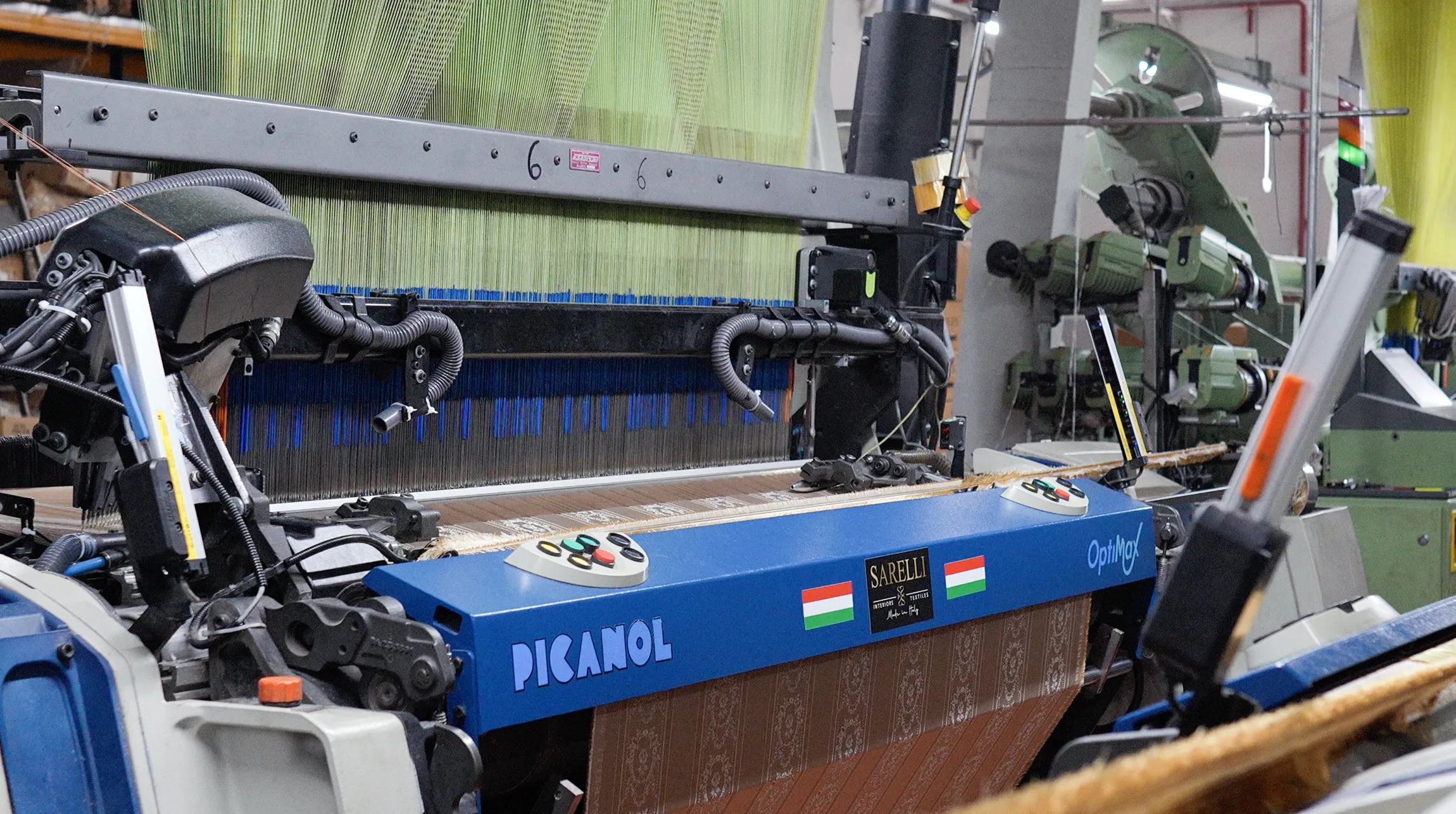
To answer how does a jacquard loom work, textile engineers examine the shedding mechanism mounted above a standard weaving machine. When buyers ask what is a jacquard loom, textile manufacturers define the machine as an advanced shedding device that manages the vertical movement of 2,400 to 12,000 individual warp threads. The weaving machine below the Jacquard head handles the horizontal insertion of the weft threads. Sarelli Interiors Textiles uses electronic Jacquard looms to manufacture patterned sheer fabrics and heavy drapery within the Sarelli Fabrics portfolio.
Jacquard Loom Mechanical Cycle: Shedding, Picking, and Beating Up
The Jacquard loom mechanical cycle consists of three primary actions executed in rapid succession: shedding, picking, and beating up. A modern industrial Jacquard loom completes all three steps between 400 and 600 times per minute during standard fabric production.
The first step of the Jacquard weaving cycle is shedding. During the shedding phase, the Jacquard head lifts a specific combination of warp threads based on the programmed pattern. The separation between the lifted warp threads and the stationary warp threads creates a temporary tunnel. Textile manufacturers call this tunnel the shed.
The second step of the Jacquard weaving cycle is picking. During the picking phase, the weaving machine propels a single weft yarn horizontally through the open shed. A modern air-jet weaving machine attached to a Jacquard head propels the weft yarn using compressed air at pressures reaching 6 bar. A rapier weaving machine uses rigid or flexible metal arms to carry the weft yarn across the shed. The weft yarn intersects the warp threads to form the woven pattern.
The third step of the Jacquard weaving cycle is beating up. During the beating up phase, a mechanical comb called a reed pushes the newly inserted weft yarn tightly against the already woven fabric. The beating up action ensures the fabric maintains a consistent density. A Jacquard fabric with a density of 250 grams per square meter (GSM) requires more force during the beating up phase than a sheer fabric weighing 80 GSM.
| Mechanical Cycle Step | Jacquard Loom Action | Duration per Cycle (Milliseconds) |
|---|---|---|
| Shedding | Jacquard head lifts 2,400 to 12,000 warp threads to form the shed. | 40 to 50 milliseconds |
| Picking | Insertion mechanism shoots weft yarn across the 140-centimeter to 300-centimeter loom width. | 30 to 40 milliseconds |
| Beating Up | Reed pushes the weft yarn into the fabric fell to secure the weave. | 20 to 30 milliseconds |
Modern Jacquard Hook Counts and Weaving Speeds
Modern electronic Jacquard looms operate with hook capacities ranging from 2,400 hooks for simple geometric patterns to 24,000 hooks for highly detailed, large-scale pictorial fabrics. The hook count directly determines the maximum width of a non-repeating pattern block.

A Jacquard loom running 12,000 hooks can control 12,000 individual warp threads across a 300-centimeter fabric width. If the warp density measures 40 threads per centimeter, the 12,000 hooks allow the loom to weave a continuous, non-repeating pattern exactly 300 centimeters wide. Sarelli Interiors Textiles specifies high hook counts for custom hospitality projects requiring large, continuous motifs. Clients can review these custom capabilities in the Projects gallery.
The weaving speed of a Jacquard loom depends on the complexity of the pattern and the fragility of the yarns. A Jacquard loom weaving a robust polyester blend for upholstery typically runs at 500 to 600 picks per minute. A Jacquard loom weaving delicate silk warp threads for luxury drapery operates at a reduced speed of 300 to 400 picks per minute. The reduced speed prevents yarn breakage during the shedding and picking phases. The Production Methods employed by Sarelli dictate strict speed limits based on yarn tensile strength.
Sarelli Interiors Textiles Jacquard Fabric Production Specifications
Sarelli Interiors Textiles manufactures Jacquard fabrics using electronic looms equipped with 6,000 to 12,000 hooks. The Sarelli production facility weaves Jacquard fabrics in standard widths of 140 centimeters, 280 centimeters, and 300 centimeters.
The Fabrics Composition of Sarelli Jacquard textiles includes pure cotton, linen blends, silk, and flame-retardant Trevira CS polyester. The flame-retardant Trevira CS polyester yarns used by Sarelli Interiors Textiles comply with the European EN 13773 fire safety standard. Sarelli weaves these Trevira CS yarns into Jacquard blackout curtains that block 99 percent of visible light. A typical Sarelli Jacquard drapery fabric weighs between 220 GSM and 350 GSM.
Sarelli also produces lightweight Jacquard sheer curtains weighing between 70 GSM and 120 GSM. The Sheer Fabrics Production process requires specialized tension control on the Jacquard loom to prevent the fine warp threads from snapping during the shedding cycle.
Buyers can explore the complete range of Jacquard patterns in the upholstery fabrics collection. Sarelli offers custom Jacquard weaving services for commercial orders exceeding 300 linear meters. The custom Jacquard development process requires 14 to 21 days for digital pattern programming and physical sampling. Clients can view physical Jacquard samples at the Sarelli Showroom or request technical specifications through the Contact department.