The jacquard loom 1804 invention is a mechanical loom attachment created by Joseph Marie Jacquard that uses stiff pasteboard punched cards to control the weaving of complex textile patterns. The punched card system introduced the concept of binary programmable instructions, which directly influenced the architecture of early mechanical computers.

Joseph Marie Jacquard patented the Jacquard machine in 1804 to automate the production of intricate textiles like brocade, damask, and matelasse. The Jacquard loom operates by reading a continuous sequence of punched cards. A hole in the card allows a specific hook to lift a warp thread, while a solid section of the card keeps the warp thread lowered. The binary action of lifting or lowering individual threads creates the textile pattern. Modern Sarelli Fabrics still rely on the binary principles established by the jacquard loom 1804 design to produce complex woven materials.
Give two uses of the jacquard loom in the development of modern computing
To give two uses of the jacquard loom in the development of modern computing, historians point to Charles Babbage adopting punched cards for the Analytical Engine in 1837 and Herman Hollerith using punched cards for the electromechanical tabulating machine during the 1890 United States Census. Both computing milestones directly copied the Jacquard loom data storage method.
Charles Babbage and the Analytical Engine data storage
Charles Babbage designed the Analytical Engine in 1837 as a mechanical general-purpose computer. Charles Babbage explicitly cited the Jacquard loom as the inspiration for the Analytical Engine input mechanism. The Analytical Engine design required two separate sets of punched cards. One set of punched cards directed the mathematical operations. The second set of punched cards stored the numerical variables. Ada Lovelace noted in 1843 that the Analytical Engine weaves algebraic patterns exactly as the Jacquard loom weaves flowers and leaves. The adaptation of Jacquard punched cards provided the first conceptual framework for separating a computer program from computer memory.
Herman Hollerith and the 1890 United States Census tabulator
Herman Hollerith invented an electromechanical tabulating machine to process data for the 1890 United States Census. Herman Hollerith used a variation of the Jacquard loom punched card to encode demographic data. Census workers punched holes in specific locations on a 3.25-inch by 7.375-inch paper card to represent age, gender, and occupation. The Hollerith tabulating machine passed electrical pins over the paper cards. The electrical pins dropped through the punched holes into mercury cups to close an electrical circuit and advance a mechanical counter. The Hollerith tabulating machine processed 62 million census records in 2.5 years. Herman Hollerith founded the Tabulating Machine Company in 1896, which merged with other entities in 1911 to form the Computing-Tabulating-Recording Company. The Computing-Tabulating-Recording Company changed its name to International Business Machines (IBM) in 1924.
What are the specific uses of the jacquard loom in the development of modern computing architecture?
The specific uses of the jacquard loom in the development of modern computing include the establishment of binary logic systems, the creation of read-only memory storage, and the invention of sequential program execution. The Jacquard loom demonstrated that complex physical actions could be reduced to a series of yes-or-no commands.
The Jacquard loom punched card system represents the first physical manifestation of binary code. A hole in the pasteboard card equals a binary 1, and a solid space on the pasteboard card equals a binary 0. Early computer programmers adopted the binary 1 and binary 0 system to write machine code. The pasteboard cards also functioned as the first read-only memory (ROM). Weavers could store a specific sequence of pasteboard cards on a shelf and reuse the sequence years later to reproduce an identical textile pattern. The ability to store and retrieve programmable instructions remains a foundational requirement for all modern computing devices.
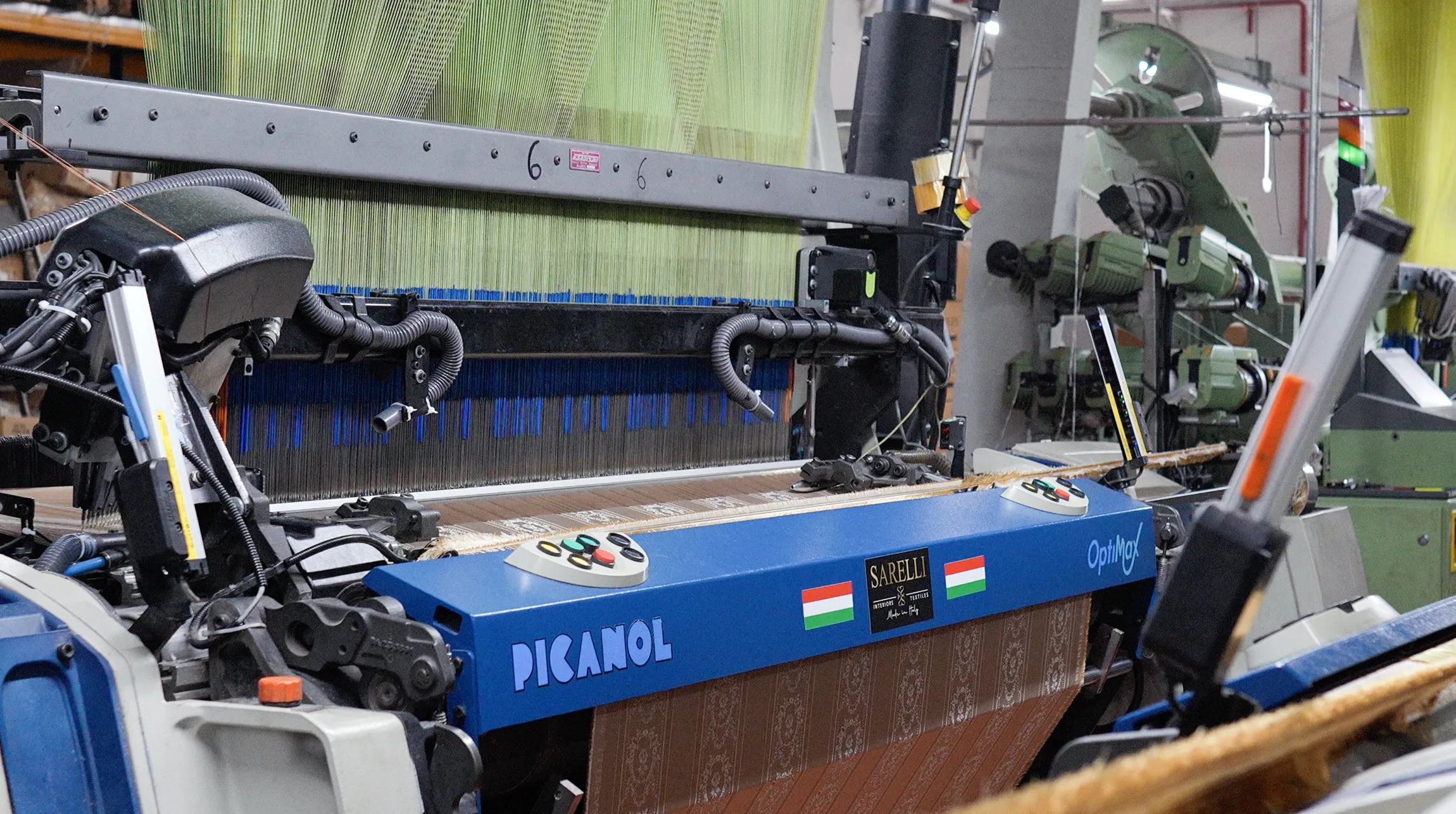
How do modern textile facilities apply Jacquard loom principles to sheer fabrics production?
Modern textile facilities apply Jacquard loom principles to sheer fabrics production by replacing physical pasteboard punched cards with computerized electronic Jacquard heads. The electronic Jacquard heads control up to 15,000 individual warp threads simultaneously to weave lightweight sheer curtains and complex drapery patterns.
The transition from mechanical punched cards to electronic computer-aided design (CAD) software allows textile manufacturers to increase weaving speeds and reduce setup times. The Production Methods used for modern Jacquard weaving involve high-speed rapier looms or air-jet looms integrated with electronic Jacquard shedding mechanisms. An electronic Jacquard loom runs at speeds exceeding 600 picks per minute. The high-speed weaving process requires precise tension control to prevent warp thread breakage when producing delicate textiles.
The Sheer Fabrics Production process uses electronic Jacquard technology to create transparent and semi-transparent window treatments. The electronic Jacquard loom weaves fine synthetic yarns or natural silk yarns with a density ranging from 20 grams per square meter (GSM) to 80 GSM. The computerized Jacquard system allows designers to embed opaque geometric patterns or floral motifs directly into the translucent sheer fabric base.
| Jacquard Loom Specification | Mechanical Jacquard Loom (1804) | Electronic Jacquard Loom (2024) |
|---|---|---|
| Data Storage Medium | Pasteboard punched cards | Digital CAD files |
| Maximum Operating Speed | 130 picks per minute | 600 to 800 picks per minute |
| Individual Thread Control | Up to 1,200 hooks | Up to 15,000 hooks |
| Pattern Setup Time | 14 to 21 days | 2 to 4 hours |
How does the Jacquard loom influence the Sarelli Interiors Textiles product line?
The Jacquard loom influences the Sarelli Interiors Textiles product line by enabling the production of highly detailed, custom-woven fabrics for residential and commercial interior design projects. The computerized Jacquard weaving process ensures exact pattern replication across large production runs, maintaining strict quality control standards for luxury interior applications.
The Fabrics Composition of Jacquard-woven textiles often includes blends of cotton, linen, silk, and fire-retardant polyester. The electronic Jacquard loom handles multiple yarn types simultaneously to create textured surfaces like brocatelle and damask. Clients can view examples of Jacquard-woven textiles in the luxury Italian fabrics. The Sarelli Interiors Textiles design team uses digital Jacquard software to translate custom artwork into woven textile patterns for specific hospitality and luxury residential installations.
Interior designers can examine the structural complexity of Jacquard-woven materials by visiting the Sarelli Interiors Textiles Showroom. The showroom displays large-scale Jacquard fabric panels that demonstrate the light-filtering properties of sheer Jacquard weaves and the acoustic dampening properties of heavy Jacquard upholstery fabrics. Professionals seeking custom Jacquard weaving services can reach out through the Contact page to discuss lead times, minimum order quantities, and custom yarn dyeing options. The Projects portfolio features completed installations containing custom Jacquard textiles in commercial environments.